Ben Giordano talks process at Refresh Binghamton.
Category: Marketing
Low price and high service is the promised land
A story about a rug
About two weeks ago my wife and I bought a carpet from a local carpet store, we were going to use it in the baby’s room that we are now prepping for the baby’s arrival. It was the only room in our house where they original wood flooring had not been refinished so we decided to get the floors refinished as well and then put the carpet down over them. But once we got the floors refinished we realized we didn’t want to cover them up with a carpet any longer so I placed a call back to the carpet store to ask them if they would give us a refund even though they had cut this carpet specifically for us. The sales person was great, he was super nice and super helpful in a way which you usually only find in a small town business or store. He let us off the hook and gave a full refund (minus the cutting costs – around $10). We would have totally understood if he didn’t want to provide the refund, he had every right to make us eat the $160 we spend on the rug, but he didn’t, he went the extra few steps to make us happy.
So now we’re looking at a smaller rug to fill the space, so that we can still see the wood flooring. However, we aren’t looking at that store again. Turns out that while they offer amazing service and great sales people, they are SUPER expensive compared to big box stores or online retailers. It’s really not fun as the customer, because I want to give the business back to them so bad, but I cannot let myself pay 50-200% more in the name of “good service.” This really got me thinking.
Not all about service?
Service is truly the next big differentiator, I mean, in a way it always has been one of the biggest places to find differentiation for your business. But now, in the wake of many tech companies outsourcing technical and other support services, it seems to be coming very much back into the spot light.
That being said, it’s not all about service, it never has been. It’s still very much about price as well. I think these two things work together in a customers mind like this: “If I pay a lot, I should get good customer service, if I don’t pay a lot I should not expect good customer service.” This is how you explain why walmart customers don’t care when they have to step over cardboard boxes in the aisles, yet whole foods’ customers would get upset if the peppers are not fully stocked, or someone cannot answer your question about the sourcing of fish or meat. Walmart customers expect crappy service, whole foods customers pay extra expecting great service.
The promised land
So the true promised land then seems to be if you could somehow offer low prices and good (or even exceptional) customer service. No customers would expect such good service at such a price point, which in-turn makes most of them very happy with what they are getting for their money.
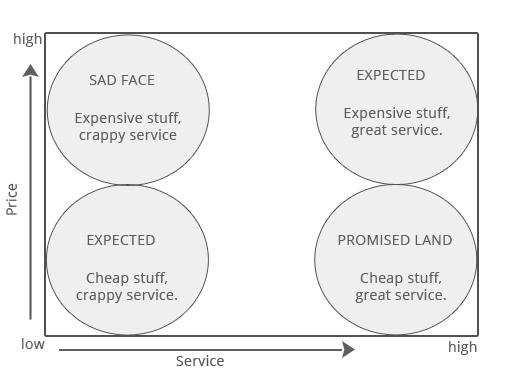
It seems like a really tough spot to try and find but I feel like the path to this promised land lies in the scale offered by the internet and technology. We can scale things so crazy well with the internet as our primary business channel and tools offered by tech advances. We can stop thinking in terms of tradeoffs between cost and service as there are so many new ways to provide service at reduced costs (and costs per additional customer). Things like support forums and 1-click installers were never available in non-tech markets. To not take advantage of these things seems crazy. I am striving for this promised land with our web design company and I think we can make it there!
Not everyone is your customer
Yesterday, my co-founder Vince was telling me a story of a scene he witnessed at a local coffee shop. The basic scene was a person being overly aggressive toward another person in the shop about the services they sell. Person ‘A’ was trying to push their product/service on person ‘B’ without any kind of knowledge of what person B’s needs or wants were. This is a scene that is very familiar to me, I see it played out all the time, sometimes in the past I have been person A, sometimes in the past I have been person B.
Getting sold to is just annoying
I think that pretty much covers it. Being person B is not a fun spot, no one wants to be sold to by someone who obviously doesn’t care. These days the buyers are so informed that they usually don’t need to be sold to, they know what they need and they know where to get it. Sales should be seen more as an educational process (in depth education vs quick research), not as a necessity to build revenue.
Qualify your customers
Don’t be person A. Don’t try selling your product or service to everyone, not everyone is your customer, dummy. This is one of the many lessons that I have learned over the past four years of being a business owner. The most important thing about deciding to qualify your customers and pin down your true target market is that everyone is happier. You magically start doing better work, your customers magically are more satisfied with the service or product they are getting. Take that extra time to make sure the fit is right between what you do best and what the potential customer’s needs or wants are.
This has a crazy snowball effect on your marketing and business growth as well. Like if you have a customer who is your perfect customer and you do an amazing job for them, not so much because you’re amazing, but more because your offering fits their need PERFECTLY, you usually get a rave review from them. Even more important other usually get a rave review from them about you and what you do. People don’t go around recommending services and products that were “okay” or “helped us get by.” However, they do go around recommending services and products that were “amazing” or “life changers.” In terms of overall marketing program and marketing strategy, word-of-mouth is still super high on the list of importance, maybe even number one on the list of marketing importance. By tightly qualifying your customers you can really push yourself towards super positive feedback and super powerful word-of-mouth.
Our Market Isn’t Online
My partner and I have been working hard on ways to grow our customer base at FreshySites. We have done very well and surpassed expectation for our first 4-5 months in business but of course, we are looking to grow even more. We had a heart-to-heart the other day when we were looking over our, to be completely honest, haphazard marketing program. For these first few months we have done the following:
- Used our current “real life” networks to spread the message about our new company
- Used social media to spread the message about our new company to current friends
- Posted 3-5 articles per week to our web design blog
- Did some solid on-page Search Engine Optimization work on our site
Really that’s pretty much all we have done and it has not been what I would call “systematic.” This is netting us around 8-10 new leads per month which is translating into about 4-5 new website projects per month. Like I said, not too bad, but also not a rate we are satisfied with.
Where is our market?
It seems almost silly for us to have to remember to do this, but we decided to talk about who are market is and where they hang out. Being very web-centric kind of dudes we spend most of our time online, doing work, reading articles, following “tweeps” (lol?).
But about 1-2 minutes into the conversation Vince and I realized that our target market does like… none, of these things. Our target market is 35+ yr old small business owners who are too busy to spend time trying to build their own website but also don’t want (or need) to pay a company thousands of dollars to do it for them. Our target market needs something simple and turn-key, something reliable and that won’t set them back in terms of time or money. Our target market reads paper books and might even read the real physical paper version of the newspaper. Our target market is for sure not on twitter and might have a facebook page but isn’t quite sure how to use it or why they should. Maybe the best realization we came to is that our target market is absolutely HUGE.
Turn this ship around captain
So once we we’re totally honest about who our target market is, where they hang out and what they look like it was very obvious to us that the majority of time we were spending on the above “marketing activities” was focused in the wrong direction. Our target market is certainly not reading our company’s blog, they are def not following us on twitter and they are most likely not seeing our updates on facebook.
Insert huge sigh here
Our problem is that these are the areas that we know how to market in. These are the exact types of marketing that we consult on. To remove the idea of blogging as a central piece of a marketing program completely blows my mind.
So what now?
Now we have to go back to learning. Learning how to execute a marketing program in the brick and mortar world that our potential customers live in. Learning what that kind of a marketing program even looks like. Here are some ideas we have come up with so far:
- Networking our faces off. Meeting new people as much as we can, whenever we can
- Brick and mortar advertising – newspapers, billboards, etc
- Getting an office space in a high traffic area
- Getting a company car and wrapping it with our brand and marketing message
- Meeting with advisors and other professionals who have succeeded in this marketing space
It’s very exciting in it’s own (mad men kind of) way. I’m excited to think that one of the major pieces of the new marketing program will be networking and getting to know more people in the local community. This has always been a really fun part of the job for me, sure you run into some people who aren’t so nice and aren’t good customers, but there are also ones who are amazing and you become really good friends with. I will keep you updated as our marketing program unfolds and takes shape, hopefully there are some online-schooled marketers out there who can learn a thing or two about real-world marketing as I do the same.